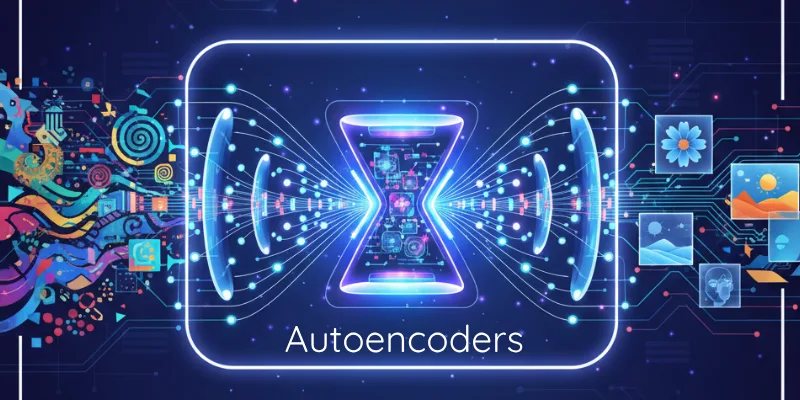
The ability of machines to understand and represent data efficiently is crucial. Autoencoders play a central role in this process. They are special types of neural networks designed to learn useful data representations without requiring labels. This concept, known as representation learning, helps AI systems discover patterns, compress information, and understand the hidden structure of data. If you are interested in mastering these concepts, an Artificial Intelligence Course in Trivandrum at FITA Academy can provide hands-on training and in-depth knowledge.
What is an Autoencoder
An autoencoder is a kind of neural network designed to replicate its input as its output. It consists of two main parts called the encoder and the decoder. The encoder takes input data, such as an image or a piece of text, and compresses it into a smaller and more meaningful form called the latent space or bottleneck representation. The decoder subsequently rebuilds the initial input from this reduced representation.
The goal of this process is not just to duplicate the input but to learn the most important features of the data. For example, when trained on thousands of face images, an autoencoder might learn to represent key features like eyes, nose, or facial shape instead of storing every pixel detail. To acquire practical understanding and direct experience in these methods, enrolling in an Artificial Intelligence Course in Kochi can help you understand how autoencoders and representation learning are applied in real-world AI projects.
The Idea Behind Representation Learning
Representation learning refers to the process where a model automatically discovers the best way to describe raw data. Instead of manually defining what features to use, AI systems learn them directly from examples. This is a major advantage over traditional machine learning methods that relied on handcrafted features.
Good representations capture the essential information of the input while ignoring unnecessary noise. For instance, in image recognition, a good representation might focus on edges, textures, or object outlines rather than the background. Autoencoders are powerful tools for achieving this because they force the model to compress information and retain only what matters most. If you want to learn these techniques in depth, joining an AI Course in Ahmedabad can provide practical training and hands-on experience with autoencoders and representation learning.
Types of Autoencoders
There are several variations of autoencoders, each designed for specific tasks. A Denoising Autoencoder learns to remove noise from corrupted inputs, helping models become more robust. A Sparse Autoencoder limits how many neurons can activate at once, encouraging the network to learn distinct and meaningful features. A Variational Autoencoder (VAE) takes the concept further by learning probabilistic representations, which are useful in generative modeling and data synthesis.
Applications of Autoencoders
Autoencoders are widely used in real-world applications. They are often used for dimensionality reduction, where large datasets are compressed into smaller, more manageable representations for analysis. They also play a vital role in anomaly detection, identifying unusual patterns in financial transactions or sensor data. In image processing, autoencoders help with image compression, denoising, and generation of realistic visuals.
Autoencoders and representation learning are at the heart of many advances in modern AI. By learning efficient and meaningful data representations, these models enable systems to understand the world with greater depth and accuracy. Whether in image recognition, anomaly detection, or generative modeling, the power of representation learning continues to shape the future of artificial intelligence. To gain comprehensive knowledge and practical skills in these areas, signing up for AI Courses in Jaipur can provide hands-on training and expert guidance.
Also check: What Is a Multi-Head Attention Layer, and Why Use It?